
More Than a Face: Why Environmental Portraits Matter for Wildlife Conservation
In wildlife photography, intimacy is often equated with impact. A tight frame, a sharp eye, a detailed face—these are the images that dominate social media and covers alike. But in an era of accelerating habitat loss and environmental change, photographs that isolate animals from their surroundings risk telling an incomplete story. Environmental portraits, which place wildlife within the landscapes they depend on, offer a more powerful and honest tool for conservation and storytelling.
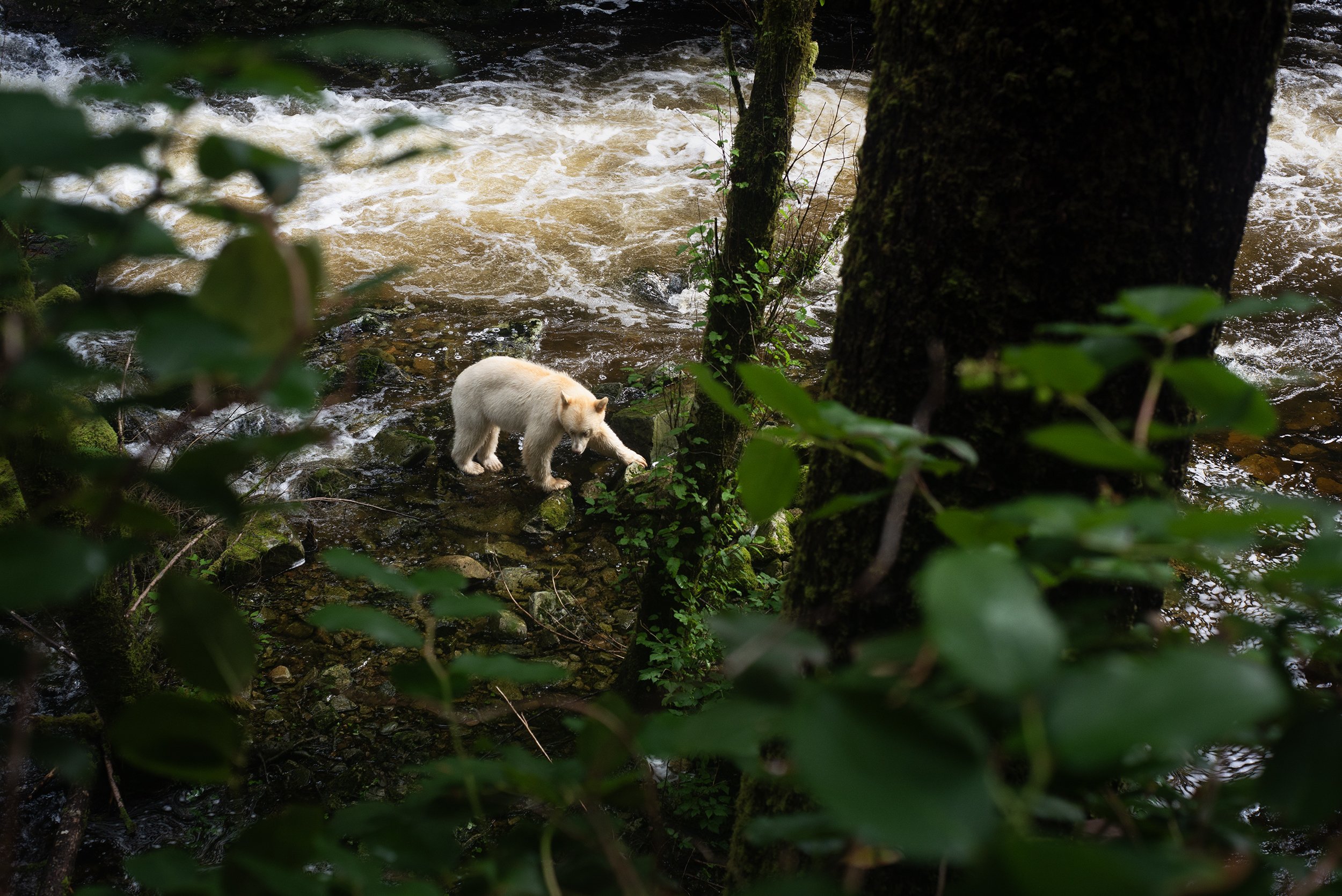
A spirit bear moves carefully through a shallow rainforest stream, its pale coat catching what little light filters through the canopy. The bear is not centered, nor dominant in the frame. It is partially obscured by leaves and tree trunks, surrounded by moving water, moss-covered stones, and dense forest growth. The photograph is not about the bear alone, but about the fragile conditions that allow it to exist at all: intact watersheds, healthy salmon runs, and old-growth forests that regulate temperature and flow. Remove the environment, and the image becomes symbolic. Include it, and the photograph becomes specific, rooted in place, and therefore rooted in responsibility.

Environmental portraits force both photographer and viewer to acknowledge scale. In the dense rainforest, a spirit bear clings to the trunk of a towering tree, partially obscured by moss and shadow. The forest overwhelms the frame, dwarfing the animal within it. This is not a portrait of dominance or charisma. It is a portrait of dependence and survival. The bear’s survival is inseparable from old-growth structure, seasonal food cycles, and the continuity of an ecosystem that is increasingly fragmented.
That same sense of scale emerges even more starkly in mountainous terrain. A spirit bear navigates a sheer granite slope, its pale form contrasted against dark rock, while her two cubs of the year, follow clumsily on the same narrow ledge above. Shot wide, the image emphasizes exposure and verticality, forcing the viewer to register risk, terrain, and movement rather than fur or facial detail. The bears occupy only a small portion of the frame, their path dictated entirely by the fractured cliff face beneath them. This is not an image about rarity or spectacle, but about access, to travel corridors, seasonal resources, and intact landscapes that still allow such routes to exist. A tight portrait would erase the difficulty of this passage. The environmental portrait insists on it.

Up-close wildlife portraits can be emotionally compelling, but they often imply a false sense of abundance and security. An animal presented without context appears timeless and resilient. Environmental portraits challenge that illusion. They show how narrowly balanced these lives truly are, and how much is at stake when landscapes are altered or lost.
From a conservation perspective, these images do more than document species. They document relationships. They show animals not as isolated icons, but as participants in complex systems that require space, continuity, and protection. For editors, conservationists, and audiences alike, this distinction matters. It shifts the narrative from “look at this animal” to “look at what this animal needs.”
Environmental portraits do not ask viewers to admire wildlife from a distance. They ask viewers to consider the land and water that sustain it. This distinction matters even more for species like the spirit bear, one of the rarest bears on Earth, whose survival is tied to a very specific place and set of conditions. To photograph a spirit bear without its environment is to strip away the very reason it exists. Environmental portraits make that connection unavoidable. They remind us that rarity is not just a matter of genetics or numbers, but of habitat, continuity, and restraint. In doing so, these images move beyond admiration and toward responsibility, offering a quieter but more enduring form of advocacy, one rooted in place, and in stewardship.
